
What Is a Design-Build Kitchen Renovation?
A design-build kitchen renovation means one team handles everything - the design, the structural work, the cabinetry, and the finishes - from the first concept sketch to the final clean-up. You are not juggling a separate designer, a cabinet supplier, and a general contractor who each update you once and leave when something goes wrong. There is one plan, one accountable team, and one fixed price.
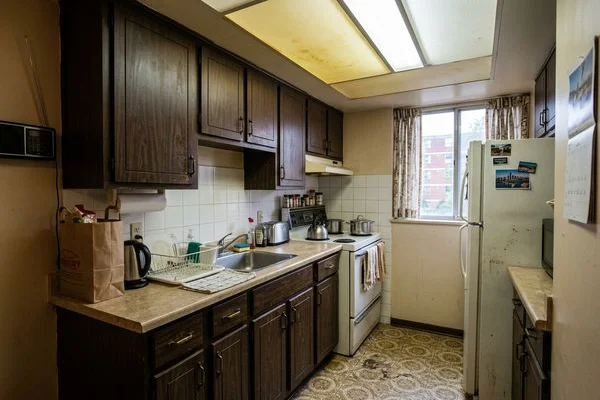
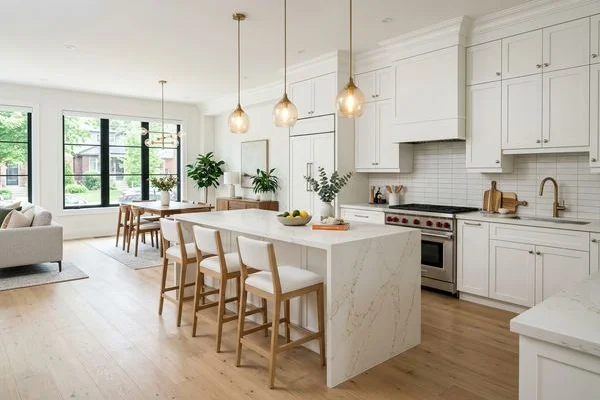
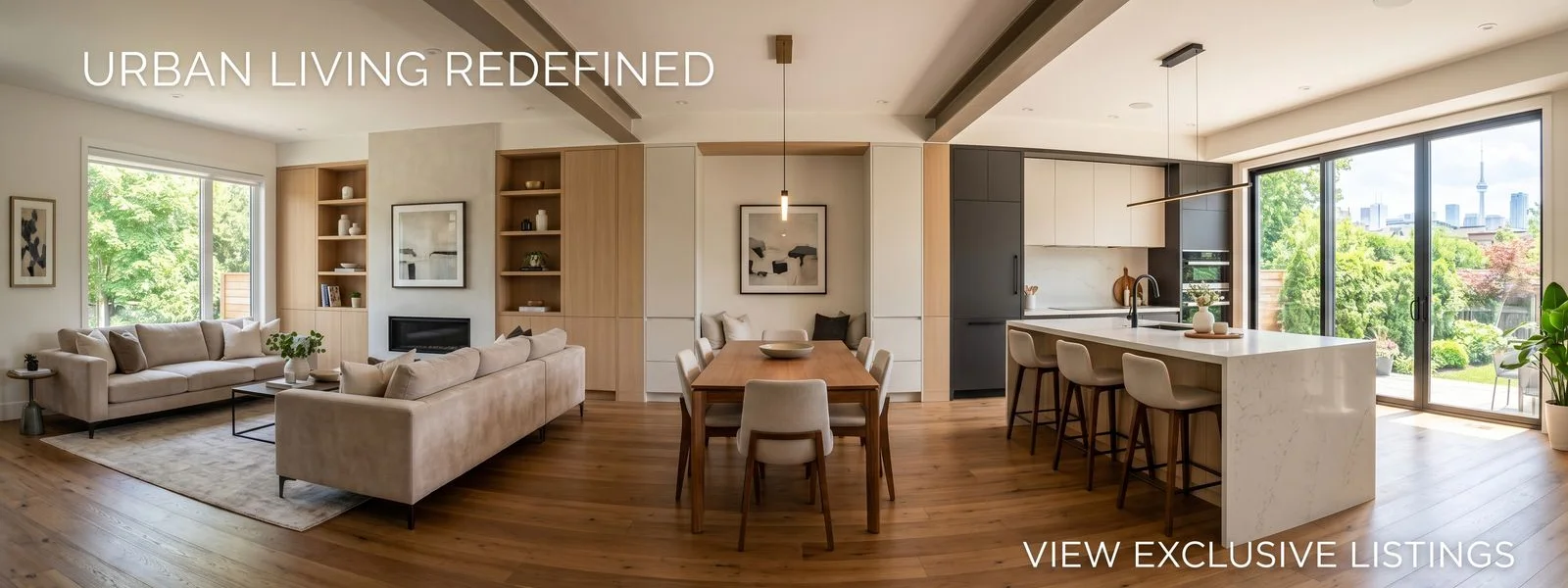
Our kitchens go beyond swapping out finishes. As a design-build renovation firm, we look at how your kitchen connects to the rest of your home. In Toronto’s older houses that usually means a small, closed-off room cut off from the dining and living areas. We open those layouts up, remove load-bearing walls with engineered LVL beams, and build ceiling-height custom cabinetry that captures the storage a stock kitchen wastes.
Every project is quoted at a fixed price after detailed pre-construction planning. We confirm the cabinetry, the countertops, the appliances, and the fixtures before the contract is signed. That means no allowances, no “ballpark” figures, and no mid-project markups when a material runs over.
What’s Included
A full kitchen renovation with us covers the whole job: layout redesign, demolition, structural changes, electrical and plumbing rough-ins, gas line installation, custom cabinetry and millwork, countertops, sinks, lighting, and the final finishing details. We also manage the City of Toronto building permit when one is required.
Common Kitchen Problems We Solve
Most Toronto homeowners come to us with the same handful of frustrations. Here is how a proper design-build renovation fixes each one.
A Cramped, Closed-Off Layout
Kitchens in homes built before the 1990s were designed as separate work rooms, walled off from family life. We remove the walls - safely, with engineered beams - and rework the floor plan so the kitchen becomes the open, connected heart of the home.
Not Enough Storage
Stock cabinets stop short of the ceiling and waste the space above. Our custom millwork runs full height, with interior fittings tailored to what you actually store, so a small footprint holds far more.
Budget Uncertainty
A renovation quoted with “allowances” almost always climbs. We specify every material during pre-construction and lock the price, so your kitchen budget is settled before the first cabinet is removed.
An Awkward Work Triangle
A kitchen can look fine and still function poorly. Our in-house designers plan the relationship between the sink, range, refrigerator, and prep space around how you cook, then show it to you in 3D before anything is built.
Planning Your Kitchen Renovation
The most expensive decision in any kitchen project is made before construction starts: the design. That is why we invest heavily in pre-construction planning. You see your new kitchen in 3D renderings, adjust the layout and finishes while changes still cost nothing, and approve a complete finish schedule. Only then do we lock in the fixed price and reserve your crew.
The result is a kitchen renovation with no guesswork - a clear plan, a guaranteed budget, and one team accountable for every detail.
Kitchen Renovation Costs in Toronto
Most full kitchen renovations in Toronto range from $25,000 to $80,000 depending on scope, finishes, and whether structural changes are involved. Projects with Caesarstone quartz countertops, ceiling-height custom cabinetry, or open-concept wall removal run toward the higher end. A professional-grade kitchen that adds a gas cooktop also requires gas line installation, typically $1,000 to $2,000 depending on line length and placement.
| Renovation Level | Typical Cost | Duration | What’s Included |
|---|---|---|---|
| Budget | $25K - $40K | 3 - 5 weeks | Stock cabinets, laminate counters, basic fixtures |
| Mid-Range | $45K - $75K | 5 - 7 weeks | Quartz countertops, custom cabinetry, tile backsplash |
| Premium | $80K - $120K+ | 6 - 10 weeks | Caesarstone, ceiling-height cabinets, open-concept layout |
Cabinetry accounts for 30 to 40% of total project cost. Custom cabinetry - built to your kitchen’s exact dimensions with soft-close Blum or Hettich hardware, dovetail drawers, and integrated lighting - costs more than stock but fits properly, lasts longer, and eliminates the filler strips and wasted corners that stock boxes leave behind. Our trade-direct sourcing removes retail markup on Caesarstone surfaces, Kohler fixtures, and custom millwork.
How Long Does a Kitchen Renovation Take?
A typical Toronto kitchen renovation runs 6 to 10 weeks from demolition to completion, plus 2 to 4 weeks upfront for design finalisation and permit approval. Permit approval from the City of Toronto Building Division can add 1 to 3 weeks for structural or gas line work - we file and manage the full permit set so you don’t track a single form.
| Phase | Duration | Key Activities |
|---|---|---|
| Design and Permits | 2 - 4 weeks | Final plans, permit submission, material orders |
| Demolition | 3 - 5 days | Site protection, tear-out, waste removal |
| Rough-Ins | 1 - 2 weeks | Electrical, plumbing, gas lines |
| Cabinetry and Countertops | 2 - 3 weeks | Custom cabinetry, Caesarstone templating and install |
| Finishing | 1 - 2 weeks | Flooring, backsplash, paint, fixtures, final clean |
For homes in older Toronto neighbourhoods - East York bungalows, Etobicoke split-levels, pre-war semis in Leslieville and Riverdale - demolition often uncovers galvanised plumbing, knob-and-tube wiring, or undersized electrical panels. Our pre-construction walkthrough documents every room before demo starts, so nothing found during tear-out becomes a mid-project change order.
Cabinet Refacing vs. Full Kitchen Renovation
Cabinet refacing replaces doors and hardware while keeping the existing box structure in place. It costs 40 to 60% less than a full renovation and finishes in about a week - the right call when the cabinet boxes are structurally sound and the layout works.
A full renovation is the right call when you want layout changes, new plumbing or electrical rough-ins, an open-concept wall removed, or upgraded countertops like Caesarstone quartz. Refacing cannot reposition the sink, add a dishwasher circuit, or fix an awkward work triangle. If you are adding a gas range or moving the island, a full renovation is the only path that gets there with permits closed and work done to code.
Permits and Technical Upgrades
Toronto requires a building permit for any structural change, new plumbing, or gas line installation. Projects touching electrical must be inspected by the Electrical Safety Authority. We manage every permit - building, mechanical, and ESA - and do not hand off a finished kitchen until every inspection is closed.
Lighting upgrades follow a layered plan: recessed pot lights for ambient coverage, under-cabinet LED strips for task lighting at the counter, and pendants over the island for accent and visual weight. Older homes often need a panel upgrade from 60-amp or 100-amp to 200-amp service before these circuits can be added safely. Range hoods are vented externally whenever duct access allows - recirculating hoods do not meet Toronto’s ventilation performance requirements for new installations.
Countertops, Cabinetry, and Fixture Selection
Countertop choice sets the tone for both the look and durability of a finished kitchen. Most Toronto homeowners renovating in 2026 choose quartz for its stain resistance and low maintenance. Caesarstone remains the most specified brand on mid-range and premium projects - the Empira White, Statuario Maximus, and Raw Concrete collections handle high-use surfaces without sealing. For clients wanting natural stone, we source granite slabs through trade suppliers at direct pricing. Porcelain slab is growing in popularity for waterfall islands and full-height backsplashes because it tolerates heat and heavy use without resealing.
Cabinetry is where budget decisions matter most. Custom cabinetry is built to the millimetre against your kitchen dimensions - no filler strips, no wasted corner space. Interior fittings include pull-out organisers, spice drawers, and waste sorting built into the cabinet footprint rather than added as afterthoughts. Ceiling-height upper cabinets with integrated LED strips underneath are standard on our mid-range and premium projects. For clients who want the look without full custom pricing, we offer semi-custom solid-wood doors on a pre-built box, which delivers 80% of the visual result at a lower cost.
Sink and faucet selection happens during pre-construction, not mid-build. Undermount sinks in stainless steel or granite composite are most requested - they create a clean counter-to-basin transition that wipes down in one pass. Kohler and Delta faucets are specified most often for their compatibility with quartz countertops and their available warranty support in Ontario.
Choosing Between a Full Renovation and a Partial Update
Not every kitchen needs a full gut renovation. Here is how we help clients decide:
Full renovation is the right call when: the layout does not work, the plumbing needs relocation, you want an open-concept wall removed, the electrical panel is undersized, or the cabinetry is structurally compromised. Full renovations require a building permit and typically take 6 to 10 weeks once permits are in hand.
Cabinet refacing makes sense when: the layout functions well, the cabinet boxes are square and solid, and the goal is a cosmetic refresh. Refacing finishes in 5 to 7 days and costs 40 to 60% less than a full renovation. It cannot move the sink, add circuits, or fix an awkward work triangle.
Appliance-only swap is sometimes the right move when the kitchen is less than 10 years old and the layout works. New appliances paired with a fresh backsplash and hardware swap can refresh the space without a permit or extended timeline. the custom result at a price point between stock and full custom. Sinks are selected by function first: undermount configurations are standard on quartz and granite because the rim-free edge simplifies cleaning and preserves countertop lines. For fixtures, Kohler and Delta are the primary brands we specify - both carry lifetime warranties and their cartridge repair parts are stocked by every Toronto plumbing supplier, which matters ten years into a project.
Plumbing Upgrades in Older Toronto Homes
Kitchen renovations in homes built before 1970 routinely encounter plumbing conditions that need correction before new fixtures go in. The most common issues are galvanised steel supply lines, which corrode internally over time and restrict flow, and original brass shutoff valves under the sink and at the dishwasher connection that no longer seal reliably.
Our standard approach on older homes is to replace supply lines to the sink, dishwasher, and refrigerator ice-maker in copper or PEX during the rough-in phase. PEX is the preferred material for new runs inside wall cavities - it handles freeze-thaw cycles, requires fewer fittings than copper, and is approved under the Ontario Building Code for residential potable water supply. Every shutoff valve gets replaced with a quarter-turn ball valve so future fixture swaps can be done without shutting off the whole house.
Gas line work for range installations is handled by our TSSA-licensed gas fitter. Toronto does not allow homeowners to connect or extend gas lines, and the inspection process requires a TSSA-certified technician to sign off before the building permit can be closed. If your project includes a gas range or gas cooktop, we schedule the TSSA inspection as part of the permit close-out sequence so there are no hold-ups on final occupancy.
Kitchen Ventilation and Range Hoods
Proper ventilation is one of the most skipped items on kitchen renovation checklists and one of the most consequential for long-term air quality and surface durability. Cooking produces moisture, grease particulates, and combustion byproducts that, without effective extraction, accumulate inside cabinet interiors and accelerate finish degradation - particularly on quartz surfaces near the range, where repeated steam exposure can compromise the resin bonding in lower-quality slabs.
The Ontario Building Code requires that range hoods serving gas ranges vent externally. For electric ranges, recirculating hoods with carbon filters are code-compliant but perform significantly below external-vent configurations. Where duct access to an exterior wall or roof penetration is available, we always recommend external venting.
Hood sizing follows a standard rule: the hood should be 6 inches wider than the cooking surface on each side, and CFM rating should be a minimum of 100 CFM per linear foot of cooking surface. For a 36-inch range, that means a minimum 600 CFM hood rated for external discharge. Zephyr, Faber, and Broan are the three brands most commonly specified on our projects across the budget, mid-range, and premium tiers respectively.
Duct insulation is required where the exhaust duct passes through an unconditioned space - typically the attic on upper-floor kitchens or exterior wall cavities in ground-floor kitchens with side-wall discharge. Without insulation, temperature differentials cause condensation inside the duct that drips back toward the hood and promotes mould growth at the duct collar.
Lighting Design: Task, Ambient, and Accent Layers
A well-lit kitchen runs on three independent lighting circuits that can be dimmed and adjusted independently of each other.
Task lighting is the functional layer - the light you cook under. Recessed LED pot lights positioned over the prep counter, island, and range provide shadow-free coverage at the work surface. Under-cabinet LED strip lights are the second task-layer element: installed inside the upper cabinet base, they illuminate the counter directly below without creating glare from the room’s ambient sources. We use Philips Hue or Lutron Caséta dimmable LED strips on projects where clients want smart-home integration.
Ambient lighting sets the room’s base illumination level. For open-concept kitchens that flow into a dining or living area, ambient fixtures need to bridge the transition without creating a hard visual boundary between zones. Flush-mount or semi-flush LED fixtures on a separate dimmer circuit allow the kitchen’s background light level to match the adjoining room’s mood without cooking task areas going dark.
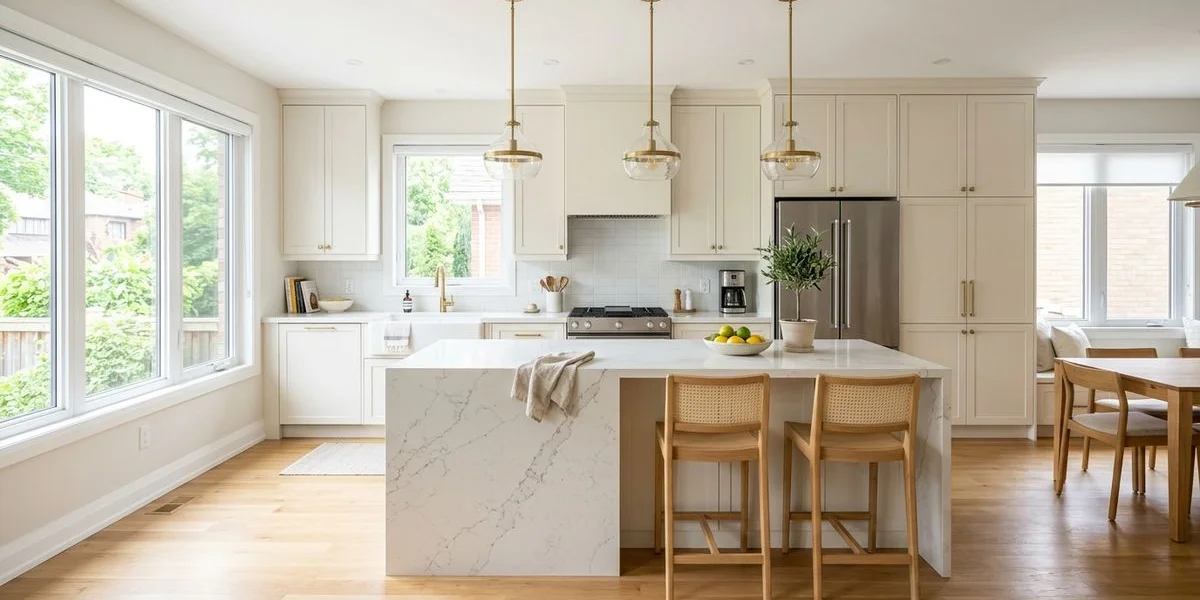
Accent lighting is the finishing layer - the component that makes a kitchen photograph well and feel considered. Interior LED lighting inside glass-front upper cabinets, LED strips in open shelving recesses, and pendant fixtures over the island all contribute to the accent layer. Pendants over the island serve both functional and aesthetic purposes: they provide focused light on the island surface while visually anchoring the island as a defined zone within the larger open-plan space.
All three circuits are wired to smart dimmers on our mid-range and premium projects. Single-gang Lutron dimmers are the most reliable option for LED compatibility - they eliminate the flicker and hum that budget dimmers produce with LED loads.
Serving Toronto and the GTA
We complete kitchen renovations across Toronto and the surrounding municipalities, including North York, Etobicoke, Scarborough, East York, Mississauga, Brampton, Vaughan, Markham, Richmond Hill, and Oakville. Our pre-construction site visit covers every renovation regardless of location - no travel fees within the GTA.
Permit requirements and inspection timelines vary slightly by municipality. Toronto Building Division is the authority having jurisdiction within the City of Toronto boundaries. Projects in Mississauga, Brampton, Vaughan, Markham, Richmond Hill, and Oakville fall under their respective municipal building departments. We manage permit applications in all jurisdictions and coordinate inspections directly with the relevant authority.
If you are planning a kitchen renovation in Toronto or the surrounding GTA, contact us to schedule a free pre-construction consultation and receive a fixed-price quote before any work begins.