
What Is Integrated Interior Design?
Most interior design happens in a vacuum: a designer creates a beautiful plan, then hands it to a contractor who has to interpret, price, and sometimes quietly redesign it. Things get lost in that hand-off - details, intent, and budget.
Our interior design service works differently because we are a design-build renovation firm. The same company that designs your space also builds it. The design you approve is the home you get, with no translation gap and no finger-pointing between a designer and a contractor.
Our in-house design team plans your space before construction starts. We handle space planning, floor plans and interior elevations, finish and material selection, and detailed lighting plans - then carry that design directly into the build. 3D renderings let you see and adjust the result before any budget is committed, removing guesswork from the most expensive decisions of your renovation.
What’s Included
Our interior design service covers discovery, space planning, floor plan layouts, interior elevations, 3D architectural renderings, material and finish selection, lighting plans, custom millwork detailing, and complete finish schedules - all of which feed directly into a fixed-price build.
Common Design Problems We Solve
Decisions Made Blind
Choosing a layout or a material from a sample chip is guesswork. Our 3D renderings let you walk through the finished space first, so you commit with confidence, not hope.
The Designer-to-Builder Gap
When design and construction are separate, the design often changes once it hits the real budget. We design and build as one team, so what is drawn is what is built.
Beautiful Plans You Cannot Afford
A design that ignores the budget leads to disappointment. Our designers work to a fixed budget from day one, so the plan you fall in love with is the plan you can build.
Layouts That Look Good but Live Poorly
A space can photograph well and still function badly. Our space planning starts with how your household actually moves through a day, so the finished home works as well as it looks.
Planning Your Renovation Design
Great design is the foundation of a smooth, predictable renovation. The hours invested in space planning, renderings, and finish schedules are what make construction fast and free of costly changes. When you design with the team that builds, every decision is made once - carefully, visually, and within budget - and then carried through to the finished home.
What Is Included in a Full Interior Design Package?
A full interior design package from our team covers every decision that affects how your renovation looks and functions - before construction begins and before any money is spent on materials you cannot return.
The package includes: floor plan layouts showing the proposed furniture arrangement and spatial flow, 3D architectural renderings showing the finished space from multiple angles with accurate material finishes, interior elevations of every significant wall showing cabinet heights, tile patterns, and millwork details, a finish schedule listing every specified material by brand, product name, colour code, and supplier, electrical and lighting plans showing fixture placement, switch locations, and circuit requirements, and custom millwork drawings with dimensions for any built-in cabinetry, shelving, or feature walls.
This level of documentation is what separates a design that gets built accurately from one that accumulates change orders.
How 3D Renderings Change the Renovation Process
3D architectural renderings are the single most valuable tool in a design-build renovation. They allow a homeowner to see and approve the finished space before demolition begins - to evaluate whether the island is the right size, whether the tile pattern reads correctly at scale, whether the lighting layout creates the right atmosphere.
Changes made at the rendering stage cost nothing. Changes made after tile is on the wall cost thousands. We invest in rendering quality because it protects the homeowner’s budget and our project schedule. Renderings are produced using current material libraries - actual Caesarstone slab textures, specific Benjamin Moore or Farrow & Ball paint shades, real cabinet door profiles - so the approved rendering reflects what will actually be built.
Interior Designer vs. Design-Build Firm
The traditional separation between interior designer and contractor creates a hand-off problem. The designer produces drawings. The contractor interprets them, prices them, and sometimes quietly modifies them to suit their trade preferences or subcontractor relationships. The homeowner approves a design and gets a slightly different result.
Our integrated model eliminates the hand-off. The same firm that designs the space builds it. The designer who specified the Schluter DITRA tile membrane and the 24x48 porcelain slab pattern is available to the tile setter when questions arise on site. The finish schedule is a construction document, not a suggestion.
ARIDO (Association of Registered Interior Designers of Ontario) members must meet education, experience, and examination requirements. Our interior design team includes ARIDO-registered designers who bring professional accountability to every project.
Spatial Flow Analysis and Furniture Planning
Spatial flow analysis evaluates how people move through a space - from the entry to the kitchen, from the living area to the dining table, through the bedroom to the ensuite. A kitchen that looks beautiful in a floor plan can still have a poorly positioned island that blocks the path between the refrigerator and the cooktop.
We model furniture placement in every space before finalising the floor plan. This determines: the correct island dimensions relative to the work triangle, the minimum clearances around dining tables and seating areas, the door swing conflicts that would otherwise only be discovered after installation, and the traffic flow between rooms in open-concept layouts.
Finish Schedules and Material Selection
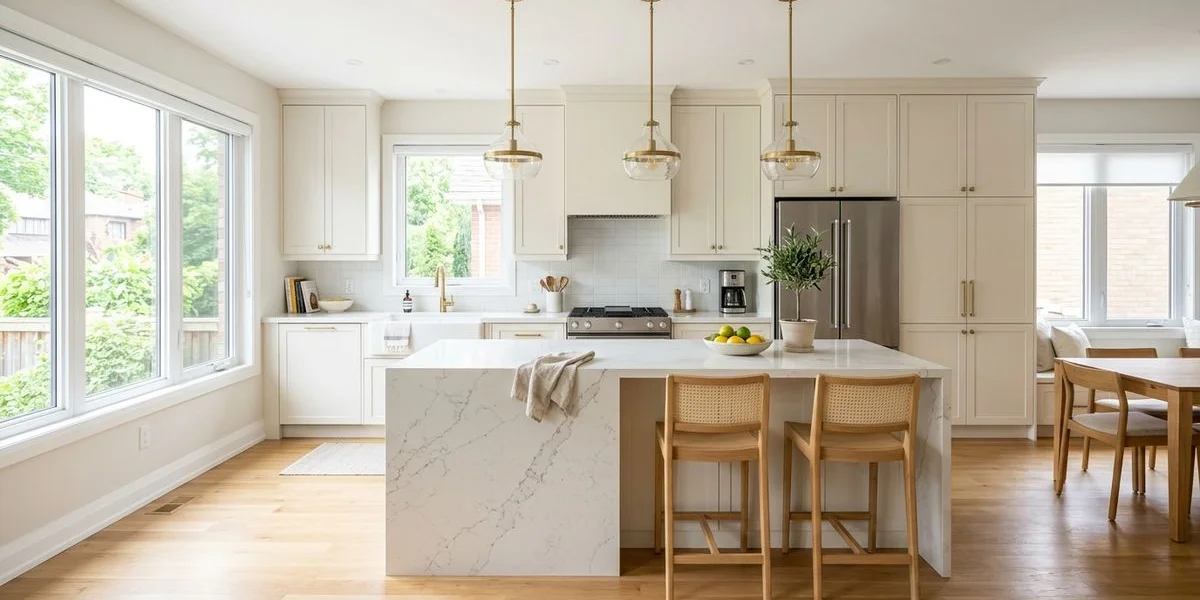
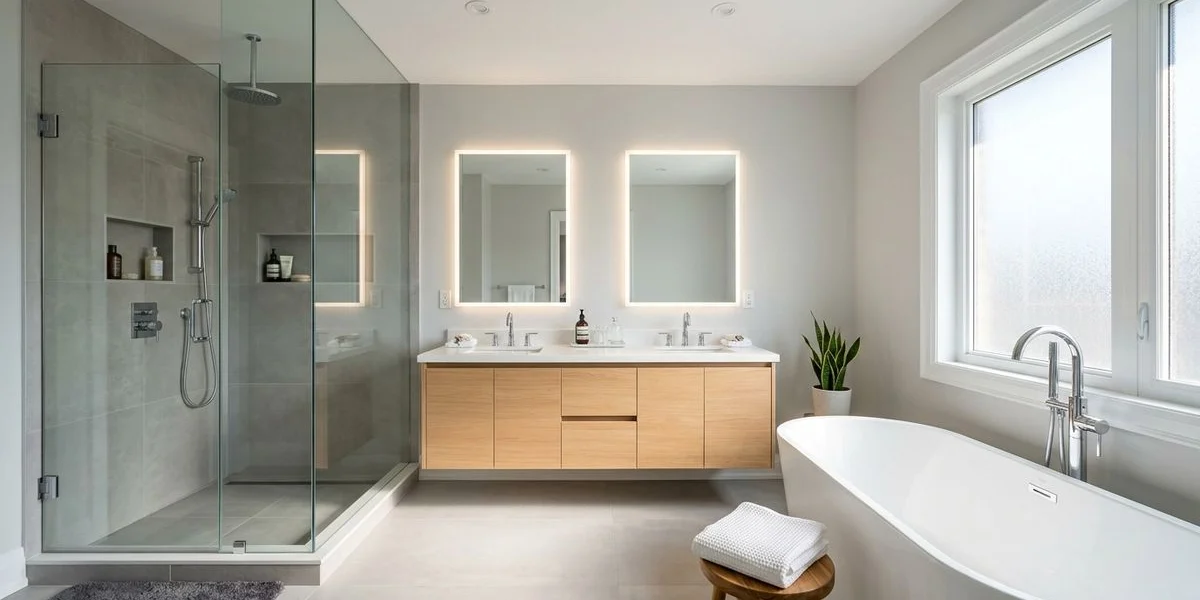
A finish schedule is a room-by-room, surface-by-surface specification document that lists every material with enough detail to order it without further clarification. For a kitchen, the finish schedule specifies the Caesarstone countertop colour and edge profile, the cabinet door style and paint code, the backsplash tile manufacturer and SKU, the grout colour and joint width, the faucet model number, and the hardware finish. For a bathroom, it covers the waterproofing membrane system, the floor tile and wall tile with layout direction, the vanity model, the mirror specification, and the towel bar finish.
Electrical and lighting plans are produced alongside the finish schedule. These plans show fixture types, locations, and circuit assignments, and are coordinated with the electrical rough-in drawings that form part of the building permit application.
Interior Design Costs in Toronto
Interior design fees in Toronto vary by scope and engagement model. Our integrated design-build pricing bundles the design phase directly into the fixed project cost, so there is no separate design retainer.
| Design Scope | Typical Cost | What’s Covered |
|---|---|---|
| Single room (kitchen or bath) | $3,000 - $8,000 | Space plan, 3D rendering, finish schedule |
| Main floor redesign | $8,000 - $18,000 | Floor plans, elevations, lighting plan, full finish schedule |
| Whole-home package | $18,000 - $40,000+ | All rooms, complete finish schedule, millwork drawings, permit coordination |
Design fees represent 8 to 15% of total project cost on most full-home renovations. The design phase is what makes a fixed-price build possible - every material, fixture, and finish is specified before the contract is signed, which eliminates allowances and mid-project change orders. Clients who skip thorough design typically pay more during construction, not less.
For context: hiring a standalone ARIDO-registered designer in Toronto typically costs $100 to $200 per hour, or 10 to 18% of total project cost on a percentage-fee structure. Our integrated model includes equivalent professional design at a cost built into the total fixed price.
Mood Boards and Concept Development
Once space planning is complete, we develop the design’s character through mood boards and material curation. Mood boards translate abstract style preferences - “warm and modern”, “heritage with updated finishes”, “Scandi-minimal” - into concrete palettes that show how materials interact under actual lighting conditions.
A mood board for a kitchen renovation might combine a Caesarstone Bianco Drift countertop sample, a brushed nickel Kohler faucet, an oak natural-stained millwork swatch, a Farrow and Ball paint chip, and a 3x12 honed Carrara tile profile. Seen together, the materials either work or they don’t - and the mood board stage is where that verdict is delivered at zero cost, before any product is ordered.
This stage produces the finish schedule foundation: a document that lists every specified material by product name, colour code, finish, and supplier. Procurement then proceeds without confusion or substitution errors. When trades arrive on site, every product choice is already locked.
Design Adaptation for Toronto’s Urban Context
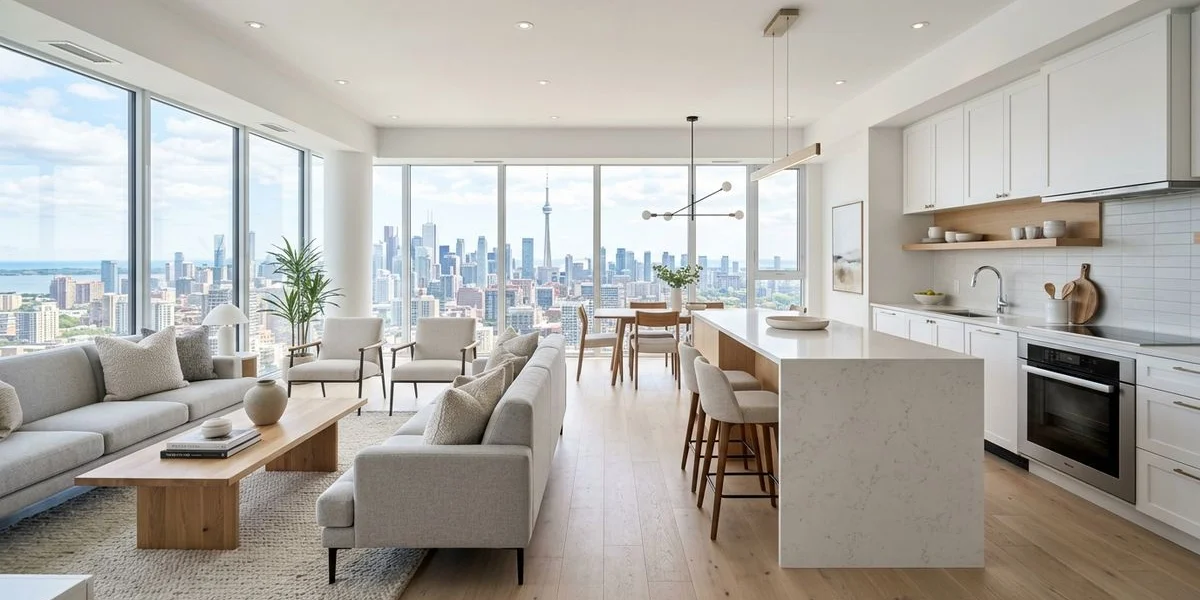
Toronto’s residential architecture spans century homes in Roncesvalles, 1960s bungalows in Scarborough, 1980s split-levels in North York, and glass-tower condominiums in the downtown core. Each building type presents different structural constraints and different opportunities for spatial expansion.
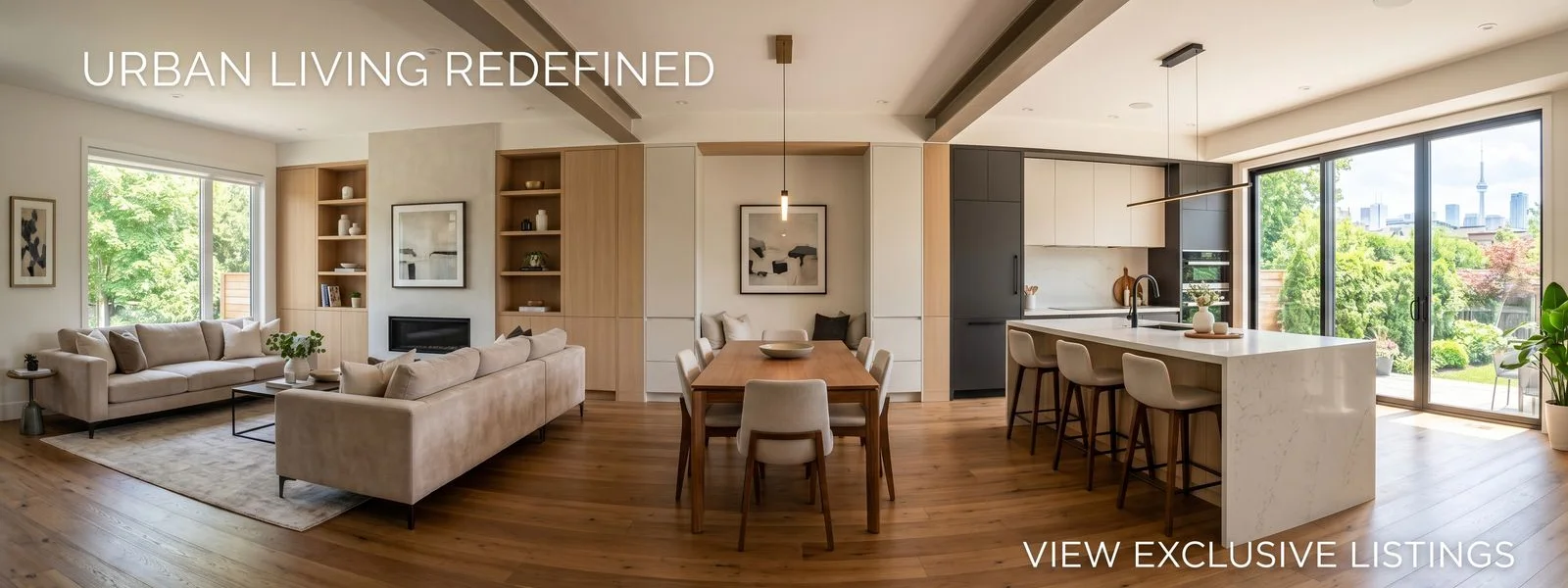
Multifunctional space design is increasingly standard in Toronto, driven by the cost of square footage. We design rooms that serve multiple purposes without looking cluttered: fold-away desks integrated into millwork, murphy beds framed as built-in cabinetry, banquette dining that provides concealed storage beneath. Every element is planned on the floor plan first, with precise dimensions confirmed in 3D renderings, so there are no surprises on installation day.
Natural light strategy varies significantly by neighbourhood and building orientation. A Liberty Village condo facing north needs a different lighting design than a Leaside semi facing south. We conduct daylighting analysis as part of space planning, identifying where reflected light can supplement direct sunlight and where artificial lighting needs to compensate. Low-profile furniture, lighter reflective surfaces, and strategic mirror placement extend natural light deeper into interior zones. Electrical and lighting plans are calibrated to these conditions - not produced generically and applied to every project the same way.
Heritage homes in Leslieville, Cabbagetown, and the Annex add a further dimension: the need to work within or sensitively extend existing architectural character. Ceiling medallions, trim profiles, casing details, and period-appropriate millwork proportions are drawn into interior elevations so the finished renovation reads as a respectful extension of the original building rather than a contrast with it.
What Design-Build Integration Looks Like in Practice
The clearest way to understand how integrated design-build differs from the traditional model is to trace where each approach creates risk and cost for the homeowner.
| Issue | Separate Designer + Contractor | Integrated Design-Build |
|---|---|---|
| Design-to-build translation | Designer’s intent interpreted by a separate contractor | Same team designs and builds |
| Scope changes | Both designer and contractor must revise; separate invoices | One revision, one team, one fixed-price adjustment |
| Material substitutions | Often made without designer involvement | Never without designer sign-off |
| Site questions | Designer must be recalled; delays possible | Designer is part of the same operation |
| Budget certainty | Design may exceed contractor’s pricing assumptions | Design is built to the approved fixed budget |
| Accountability | Split between two separate businesses | Single point of contact throughout |
This integration is particularly valuable on complex projects - whole-home renovations, additions, or condo gut-renovations - where design decisions cascade into structural, mechanical, and permit requirements simultaneously.
Electrical and Lighting Plans in Practice
Electrical and lighting plans are technical documents, not decorative guidelines. They specify every circuit, outlet location, and fixture type in the renovation - information that goes directly into the building permit application.
A lighting plan for a renovated kitchen addresses: pot light spacing and beam angle to eliminate shadow gaps on work surfaces, under-cabinet LED strip lighting on a separate dimmer, pendant fixtures over the island at a specified height above the countertop, a dedicated circuit for high-draw appliances, and switch locations that control each zone independently.
Reflected ceiling plans coordinate the lighting layout with bulkhead locations, coffers, and soffit changes proposed in the millwork drawings. When lighting and millwork are designed together - as they are in our integrated model - pot lights don’t land inside a bulkhead edge and pendants are centred over the island without requiring field adjustment.
Finish schedules cross-reference every fixture with a manufacturer name, model number, and specified finish (brushed brass, matte black, brushed nickel). This eliminates the substitution risk that arises when a contractor sources fixtures without a complete specification.
Permits, BCIN, and Design Documentation
Interior design decisions have direct implications for permit requirements. Removing a wall - even a non-load-bearing one - requires a building permit if it affects electrical rough-ins or plumbing chases. Reconfiguring a bathroom that moves a shower drain requires a permit and, in a condominium, condo corporation approval and possible core-drilling authorization.
We flag permit triggers at the design stage, before floor plans are finalised. This prevents the scenario where a homeowner approves a design that requires revision to obtain a permit. The finish schedule, millwork drawings, and electrical plans produced during the design phase form part of the permit application package - filed by our team and closed by our team at project completion.
For permit applications that require drawings produced by a registered designer, our team includes designers with BCIN (Building Code Identification Number) credentials who can produce and seal the relevant documentation.
Serving Toronto Homeowners Across the GTA
Our interior design service supports renovations across the full GTA: the City of Toronto, North York, Etobicoke, Scarborough, East York, Mississauga, Vaughan, Markham, and Richmond Hill. Each area presents its own housing stock - bungalows, semis, detached century homes, mid-century splits, and high-rise condominiums - each with its own design opportunities and structural constraints.
Design consultation and 3D rendering review sessions are conducted on-site and in our studio. All design documentation - floor plans, elevations, finish schedules, lighting plans, and millwork drawings - is shared digitally and remains accessible throughout the project. When construction begins, the approved design travels with the project, not in a separate designer’s filing cabinet disconnected from the team doing the work.
Custom Millwork: Where Design Becomes Architecture
Custom millwork is the element that most distinguishes a well-designed renovation from a renovated room. Standard cabinetry fills space. Custom millwork defines it - built to the exact height, depth, and profile of the room it lives in, integrating appliances, concealing mechanical elements, and creating architectural features that read as permanent parts of the building.
Our millwork process begins in the interior elevations: dimensioned drawings of every significant wall showing cabinet heights, reveal dimensions, panel proportions, and hardware placement. These elevations are reviewed in 3D renderings before fabrication begins. Once approved, they become shop drawings for the millwork fabricator.
Custom millwork projects we regularly execute include: full-height shaker kitchen cabinetry with integrated panel-ready refrigerators and dishwashers, built-in entertainment units in living rooms with concealed cord management and floating shelving, custom bathroom vanities with integrated sinks and under-counter storage, mudroom built-ins with bench seating, coat storage, and cubby systems, and home office millwork with integrated desk surfaces and floor-to-ceiling shelving.
Material specifications for millwork typically reference finish type (painted, stained, or natural), substrate (MDF for painted, hardwood veneer for stained), hardware brand and finish (Emtek, Richelieu, or similar trade suppliers), and interior finish details. All of this is documented in the finish schedule before any material is ordered.
Because our millwork drawings are produced to shop-drawing standard - with precise dimensions, substrate specifications, hardware call-outs, and reveal details - fabricators can build directly from them without field measuring, and installations proceed without costly last-minute revisions.